Enjoy your plants!
Showing posts with label Echeveria setosa var. ciliata. Show all posts
Monday, February 27, 2012
Another Echeveria Flower
This is the flower of Echeveria setosa var. ciliata, at least the one we have listed in our catalog as such. It was originally purchased as Echeveria ciliata, but it's a little different than what most expect under that name, especially in the flower. And an outstanding flower it is.
Sunday, September 12, 2010
Echeveria setosa revisited
Lynn-Marie felt I wasn't really clear when I wrote about Echeveria setosa var. ciliata. I agree. I've made some changes in that post, but it probably still needs revision. Sorry.
Wednesday, September 8, 2010
Echeveria setosa var. ciliata
(Re-written Sept. 12, 2010) Because of the wide variability of Echeveria setosa throughout its range as well as within the varieties the trend has been to consider the complex as one species. This variety, often sold as Echeveria ciliata, falls somewhere in the middle of the complex, between var. oteroi and var. setosa. Even the variety status is in question, but clearly some distinctions need to be made. Reid Moran, writing in the C& S Journal in 1993 wrote:
"As with E. ciliata at the type locality, the plants of one population may differ so much among themselves that someone growing them side by side without knowing their common origin might easily suppose they needed different botanical names. (For example, compare Figures 7 and 8 or 10 and 11.) From the taxonomist's viewpoint, of course, they do not— though the horticulturist might think some cultivar names appropriate."
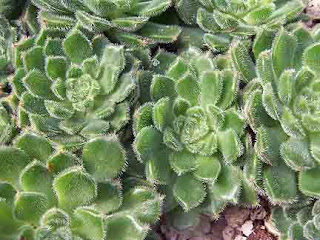
We received the plant below as Echeveria ciliata, but it doesn't really represent what most would consider to be E. setosa var. ciliata, as the surface of the leaves are more hirsute than one would expect. If I were selling it, I would label it Echeveria setosa and let the buyer decide which variety it belongs in.
All of this may confuse more than help, and that's to be expected in such a variable species. But for the collector the differences are clear enough for it to make sense to grow all the different forms, be they varieties or not.
"As with E. ciliata at the type locality, the plants of one population may differ so much among themselves that someone growing them side by side without knowing their common origin might easily suppose they needed different botanical names. (For example, compare Figures 7 and 8 or 10 and 11.) From the taxonomist's viewpoint, of course, they do not— though the horticulturist might think some cultivar names appropriate."
We received the plant below as Echeveria ciliata, but it doesn't really represent what most would consider to be E. setosa var. ciliata, as the surface of the leaves are more hirsute than one would expect. If I were selling it, I would label it Echeveria setosa and let the buyer decide which variety it belongs in.
All of this may confuse more than help, and that's to be expected in such a variable species. But for the collector the differences are clear enough for it to make sense to grow all the different forms, be they varieties or not.
![]() |
| Echeveria setosa var. ciliata ? |
Subscribe to:
Posts (Atom)

